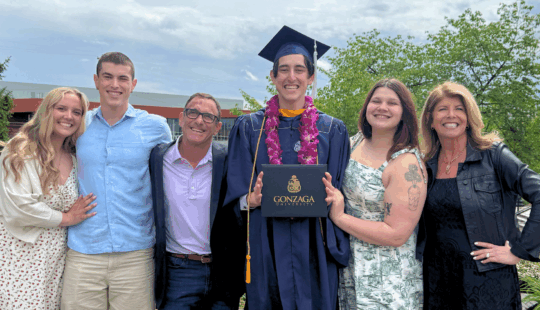
Michael was weeks away from starting college when his life changed forever.
Fresh out of high school and preparing to begin his freshman year at Gonzaga University, Michael collapsed at home one summer morning. What initially seemed like a sudden accident quickly became something far more serious. Scans revealed a brain tumor — an aggressive diagnosis that forced Michael and his family into a world of hospitals, treatment plans, and uncertainty almost overnight.
For families facing pediatric brain tumors, this moment is often where everything changes. Futures are paused. Priorities are reshaped. And parents are forced to make impossible decisions while learning an entirely new medical language.
When Families Become Advocates
Michael’s treatment journey included multiple surgeries, weeks of radiation, and a year of chemotherapy. When his tumor returned, the prognosis was devastating. Options were limited, and time felt painfully short.
That’s when Michael’s mother, Joanna, became his fiercest advocate.
She pursued second opinions, navigated insurance barriers, coordinated care, and fought for access to emerging treatment options. Her persistence led Michael to a rare, high-risk laser ablation surgery and a new medication plan — a turning point that ultimately changed the course of his life.
Today, Michael has been cancer-free for nearly two years. He graduated Summa Cum Laude, is engaged, and is applying to medical school, hoping to become an oncologist who understands both the science and the human side of care.
Why Advocacy Is Critical for Pediatric Brain Tumors
Pediatric brain tumors remain one of the most complex and underfunded areas of childhood cancer. According to the National Cancer Institute, brain tumors are the leading cause of cancer-related death in children.1 Despite this reality, limited attention and investment in pediatric brain tumors often mean families face delays, uncertainty, and fewer options from the very start of their journey.
Many families spend months seeking answers to early signs of brain tumors or unexplained brain tumor symptoms before receiving a diagnosis, losing precious time along the way. Even after diagnosis, families often face systemic barriers that make an already devastating situation even harder to navigate.
These challenges include:
- Limited treatment options
- Delayed progress in tumor research
- Barriers to accessing specialized care
These gaps are not accidental. They reflect long-standing policy and funding decisions that have failed to prioritize pediatric brain tumors at the same level as adult cancers. Advocacy exists to close those gaps — so outcomes are not determined by luck, location, or a parent’s ability to navigate an overwhelming system.
How Pediatric Cancer Advocacy Creates Change
Advocacy is often the difference between stalled progress and lifesaving breakthroughs for children facing pediatric brain tumors. Despite decades of progress in cancer research, less than 5% of federal cancer research funding is directed toward pediatric cancers2, limiting the pace at which new treatments and clinical trials become available for children.
While researchers and clinicians work tirelessly to improve outcomes, their work depends on sustained investment, supportive policy, and public awareness. Advocacy ensures pediatric brain tumors remain a national health priority — not a niche issue competing for limited attention and resources.
When advocates raise their voices, they help drive change by:
- Protecting and advancing funding for tumor research through federal and state budgets
- Pushing for pediatric-specific policies that recognize children are not “small adults” in cancer care
- Ensuring families and survivors are represented in decisions that shape treatment access and research priorities
- Increasing public awareness so pediatric brain tumors are not overlooked in broader cancer conversations
Most importantly, advocacy brings families into the conversation. By sharing experiences like Michael’s, advocates transform individual stories into collective momentum — turning rare successes into more achievable outcomes and helping build a future where every child facing a pediatric brain tumor has access to better options and better hope.
Turning Stories Into Action
At the Pediatric Brain Tumor Foundation (PBTF), advocacy is central to the mission — because progress for children with pediatric tumors doesn’t happen by accident. It happens when families, survivors, and supporters are empowered to speak up for better research, better care, and better policies.
PBTF’s advocacy programs focus on protecting and advancing funding for pediatric brain tumor and cancer research, educating lawmakers about the unique needs of children, and ensuring family voices are represented in decisions that shape care and treatment options. By engaging directly with policymakers and mobilizing a national network of advocates, PBTF works to keep pediatric brain tumors visible in federal and state health priorities.
Through advocacy days, grassroots campaigns, and ongoing policy engagement, PBTF turns lived experience into influence — helping families move from navigating crisis to driving change.
Your Voice Can Shape the Future
You don’t need medical training or policy expertise to make a difference. Advocacy can begin with learning the warning signs, sharing a story, or taking a simple action that supports children facing pediatric brain tumors.
Every voice strengthens the movement. Every action helps ensure the next family has more options, more hope, and more support.
Stand Up for Kids With Pediatric Brain Tumors
Michael’s story shows what is possible when families have access to care, research, and pediatric cancer advocacy. But no family should have to fight alone — and progress should never depend on chance. Join PBTF’s advocacy efforts and take action today.
BECOME AN ADVOCATE
Together, we can turn survival into progress — and stories into change.
Sources
1 Brain & CNS Tumors – https://training.seer.cancer.gov/brain/tumors/
2 Advancing Pediatric Cancer Research and Patient Care through Evidence-Based Policies – https://cancerprogressreport.aacr.org/pediatric/pcpr25-contents/pcpr25-advancing-pediatric-cancer-research-and-patient-care-through-evidence-based-policies/