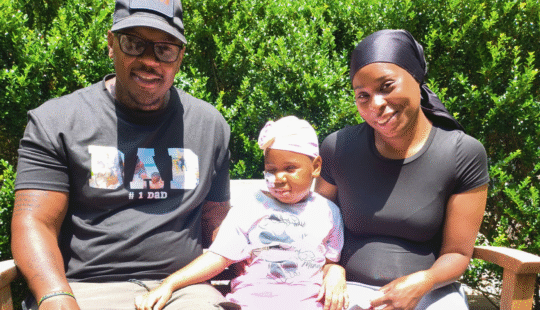
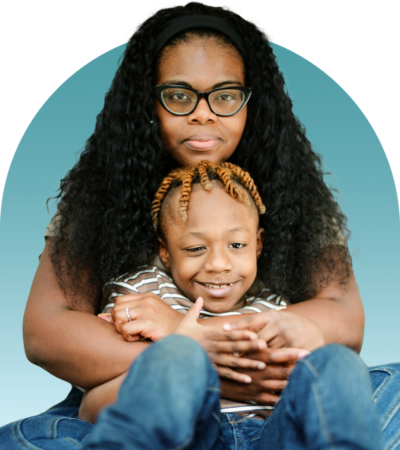
From the moment she arrived, four-year-old Nava has been a bright spark—an energetic little girl who loved to dance, sing, and charm every person she met. “She’s always been the center of attention,” her mom, Yasmin, shared. “She’s that kid who walks into a room and everyone knows she’s there.”
But last year, that spark began to dim.
What started as small changes—a shift in her energy, sudden weight gain, frequent accidents at school—slowly grew into something much more alarming. “She wasn’t herself,” her parents remembered. “She was sleeping a lot, not talking, not wanting to play. Our daughter was a twig her whole life, and suddenly she was gaining weight so fast. And the headaches… no four-year-old should have migraines every day.”
Their concerns were dismissed again and again. But when Nava went three days without eating and could barely stay awake, her parents rushed her to the ER.
That’s when everything changed.
A Devastating Discovery
Within hours of arriving at the emergency room, Nava’s symptoms worsened. She vomited for the first time since her decline began, and doctors ordered a scan. Yasmin and her husband were escorted to a conference room—something every parent dreads.
“She tried to talk around it,” they said of the doctor. “We told her, ‘If it’s something bad, just tell us.’ And she did. She said it straight: ‘She has a brain tumor.’ It was the size of a golf ball.”
In a moment, the world tilted.
The next day, Nava underwent emergency brain surgery. Her parents were told it had gone well—that most of the tumor was removed and she was “in good hands.” They clung to that hope.
But when Nava didn’t wake up for nearly three weeks, red flags turned into deep fear. They kept asking doctors if her prolonged sleep was normal, and what complications had occurred. “We were told not to worry,” they explained. “But every time a new symptom appeared, that’s when they’d finally tell us what had happened during surgery.”
It wasn’t until much later that her parents learned the truth: a drain had been placed incorrectly, causing bleeding and a stroke. The surgery had left half the tumor behind. Nava lost vision, developed left-side weakness, and faced cognitive and hormonal challenges that would change the course of her life.
“We didn’t know,” her dad, David, said quietly. “If we had known, we would have gone somewhere else from the start.”
A Second Chance—and a Second Battle
After months of confusion and inconsistent information, Nava’s parents sought a second opinion at Children’s Hospital of Philadelphia (CHOP). The difference was immediate.
“They told us everything upfront—the possibilities, the risks, the reality,” they said. “They showed us the scans. They told us half the tumor was still there.”
Nava underwent a second surgery, this time using a less invasive approach through her nasal cavity. “He cleaned it out,” her dad shared. “We saw the pictures. He got 98% of it. She woke up the next day. It was nothing like the first surgery.”
Their relief was short-lived. This fall, scans showed that Nava’s tumor is growing back—this time as a cystic fluid-filled mass. It’s growing slowly, but it’s growing.
“We asked what could be done,” they said. “And the answer was basically: we have to wait for it to get bigger. Then she’ll need another surgery. Radiation is not an option. There’s no medicine for this.”
Despite everything she has endured, Nava’s spirit has not dimmed.
“She’s still happy, still dancing, still being herself,” her mom said. “Her spirit never broke.”
The Stress Families Carry
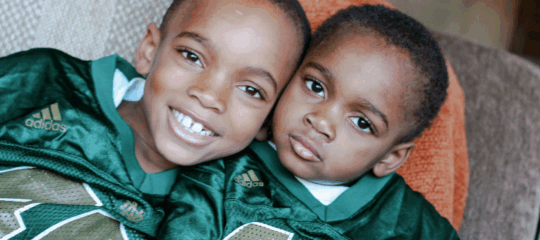
Nava’s two younger brothers—just two and three years old—miss their sister every day. They visit the hospital, eager to hug her, only to be met with her familiar sass: “Be quiet, y’all are too loud.”
But the strain on the family is real.
“It’s overwhelming,” her parents admitted. “We had to drop everything—work, bills, everything—because nothing is more important than her. Now we’re trying to put life back together, but everything is in chaos.”
When asked what they hope other parents take from their story, they answered without hesitation: “Listen to your kids.”
How PBTF Is Walking Beside Them
Throughout their journey, the Pediatric Brain Tumor Foundation has provided support to help lighten the family’s load—small but meaningful ways to make unbearable days a little easier.
The PBTF team connected the family with:
- Uber Eats vouchers, ensuring they could have hot meals at the hospital during long bedside days and nights.
- Sibling Support resources, giving Nava’s little brothers a space that focuses on their emotions and experiences.
- Connections with PBTF’s Family Health Resource Specialist, offering unbiased guidance, educational tools, and answers to medical questions outside the pressure of the hospital environment.
“It’s one less thing to worry about,” PBTF staff told the family, echoing something parents in crisis rarely hear: you’re not alone.
Still Her Bright, Bossy Self
Even now, navigating vision loss and mobility challenges, Nava has the same spirited personality she had before any of this began.
“She still bosses her brothers around,” her mom laughed. “She still loves dancing. She talks about going home to them every day.”
Their hope is simple: that soon, she will.