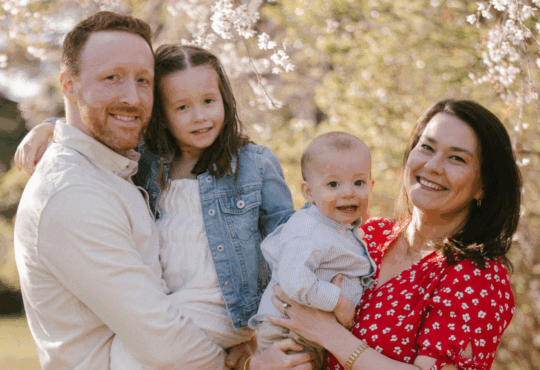
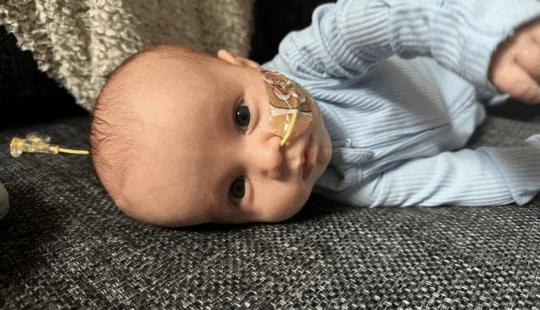
The following story was written by Nate’s Father, Matt.
We welcomed our first child, Nate, on May 2, expecting the familiar joys and challenges of new parenthood: sleepless nights, endless feedings, and a parade of family falling in love with his tiny face. For six weeks, that’s exactly what life was—ordinary and wonderful. Nate had a knack for pulling a smile from everyone he met. Then, something changed. His cries sounded different. He grew lethargic, struggled to eat, and began vomiting rather than just spitting up. As first-time parents, we didn’t know what was wrong—just a gut feeling. “Maybe it’s reflux,” we told ourselves.
On June 20, our world shifted. At a pediatrician visit for his reflux symptoms, Nate’s temperature was alarmingly low. We were sent straight to the Children’s Hospital of Philadelphia (CHOP) emergency department—a ten-minute drive that may have saved his life. By the time we arrived, Nate was slipping toward unresponsiveness. The ER room filled quickly—what started with two doctors swelling to more than twenty clinicians (doctors, nurses, social workers, and others) as we were moved to the trauma bay.
A CT scan confirmed the team’s worst fears after they noted pressure at his soft spot: a large mass was blocking the normal flow of cerebrospinal fluid. In a quiet room, I’ll never forget the ICU team drawing a simple sketch of Nate’s head—two circles for his ventricles and a third circle with a devastating message. At seven weeks old, Nate had a choroid plexus tumor. It’s a rare diagnosis—St. Jude estimates roughly 75 to 80 children are diagnosed with choroid plexus tumors each year.
Less than one hundred.
One.
Hundred.
(That’s still hard for me to swallow. It’s a rare condition, but when your child gets the diagnosis, those low odds become your 100% reality.)
Neurosurgeons moved quickly that night, placing an external ventricular drain (EVD) to relieve the pressure in Nate’s brain. During the surgery, a neuro-oncologist stepped into our room for the first time. I remember saying, “Why is a neuro-oncologist in our room? Why does our son need an oncologist? You must be in the wrong room.” They weren’t.
From that moment on, our team—neurosurgeons and neuro-oncologists together—walked us through the plan, which included a tumor biopsy. The neurosurgeons described the risks as “potentially catastrophic.” The biopsy surgery lasted over seven hours, but the team successfully obtained a sample to determine the tumor’s grade. Then came waiting for pathology results, which stretched time in ways I didn’t know were possible. Each day, we met brilliant, compassionate clinicians who said the same honest thing: “We need the pathology.” When the results finally arrived, it was the best news we could have hoped for. Nate’s tumor was a choroid plexus papilloma, WHO grade 1—benign. It didn’t erase the road ahead, but it gave us something we hadn’t felt in days: the ability to breathe again and hope for the future.
We spent three weeks inpatient at CHOP. Our families spent countless hours in that hospital room, ensuring we were never alone. Friends sent gift cards and comforts for our unexpected stay—mattress toppers, storage bins, snacks. The clinical care was extraordinary; the human care was just as profound. We were asked if CHOP could bank Nate’s tumor tissue and clinical data to support research through the Children’s Brain Tumor Network. We didn’t hesitate. Parents before us had made our path clearer; saying yes felt not just like an obligation, but a privilege to help the next family’s child.
Now we’re home, learning a new normal. Nate is doing what babies do—growing, playing, and watching Phillies games as if tracking every pitch. He will need another surgery to remove the tumor completely; the team is timing it for when he’s a bit older and stronger to minimize risks. Until then, we count small victories: a steady feed, deeper sleep, a laugh we hadn’t heard before. Every cry still makes us pause, but we’re so grateful for every moment we spend with Nate. Grateful for our families and community that lifted us up, and for the clinicians who saved his life.
We share Nate’s story to honor the people who cared for “Nate the Great,” to thank the community that carried us, and—most of all—to stand beside the next parent who finds themselves in a trauma bay hearing words they never imagined. Even at just seven weeks, Nate showed us what resilience looks like. His smile still lights up every room. If our experience helps another family trust their instincts, speeds a researcher’s insight by even a day, or eases a night on a hospital couch for a mom or dad, then this hard road has yielded something truly good.
**********
The Pediatric Brain Tumor Foundation (PBTF) has been an important support for Matt and his family throughout Nate’s challenging journey. From providing the Starfolio, a resource for newly diagnosed families to helping Nate’s mother, Nicole, find connection through PBTF’s support group, PBTF will be there every step of the way. As Nate prepares for upcoming surgery, PBTF remains steadfast by their side, offering continued guidance and resources tailored to their evolving needs, embodying compassion, strength, and unwavering hope for families facing similar battles.
If your family is in need of support, don’t hesitate to reach out to our Family Support team at [email protected].
One mother shares her perspective about pediatric brain cancer's impact on the entire family.